
New York (Sept. 25, 2026) — As scientists and policymakers increasingly consider environmentally based approaches to climate mitigation, a new international coalition of research organizations is calling for rigorous, coordinated study of iron-based carbon removal.
Oceanry together with the ExOIS Field Research Coalition, convened by Exploring Ocean Iron Solutions (ExOIS), bring together independent organizations developing iron-based field programs in different regions of the global ocean. The coalition aims to advance scientific understanding through greater coordination, information sharing, transparency, and common standards for responsible research.
Founding members have signed a voluntary charter committing to scientific excellence, environmental stewardship, transparency and scientific independence, collaborative learning, and research conducted in the public interest. In addition, members have committed not to seek direct financial gain from their research during the experimental phase, including through the sale of carbon credits and offsets, helping to ensure that research findings remain impartial and independent.
The coalition also recognizes that iron-based carbon removal and other ocean-based climate-mitigation techniques remain areas of active scientific investigation. Their potential effectiveness, environmental impacts, risks, and broader implications require continued research and careful evaluation before conclusions can be drawn about their suitability or scalability as climate-mitigation strategies.
“We need to better understand potential climate solutions as soon as possible, but that urgency must be matched by scientific rigor and environmental responsibility,” said Ken Buesseler, Executive Director of ExOIS and Emeritus Research Scholar at the Woods Hole Oceanographic Institution (WHOI).
Rapid reductions in greenhouse gas emissions remain a high priority for addressing climate change, but scientific assessments also indicate that new technologies, including carbon dioxide removal, are needed to meet long-term climate goals. Ocean iron replenishment is one of several potential mCDR approaches being investigated. It involves adding small amounts of iron to iron-limited regions of the ocean to stimulate phytoplankton growth, which in turn enhances the natural processes that transport carbon from the surface ocean into deeper waters. Earlier field experiments have demonstrated that iron additions can stimulate phytoplankton blooms, but uncertainties remain about how much additional atmospheric carbon dioxide can ultimately be removed, how long that carbon is stored, and whatecological and biogeochemical effects could result. Carefully designed field studies are needed to answer these questions.
The coalition’s founding members are pursuing their own distinct research pathways in different ocean environments. ExOIS is developing the North Pacific Carbon Study in the iron-limited Northeast Pacific; Growing Oceans has carried out initial field research in low-nutrient, low-chlorophyll waters near Tonga; Oceanry, a Finland-based nonprofit, is developing their plans for ocean iron research in the North Atlantic; and the Southern Ocean Field Experiment Consortium is developing plans for field research in the Southern Ocean.
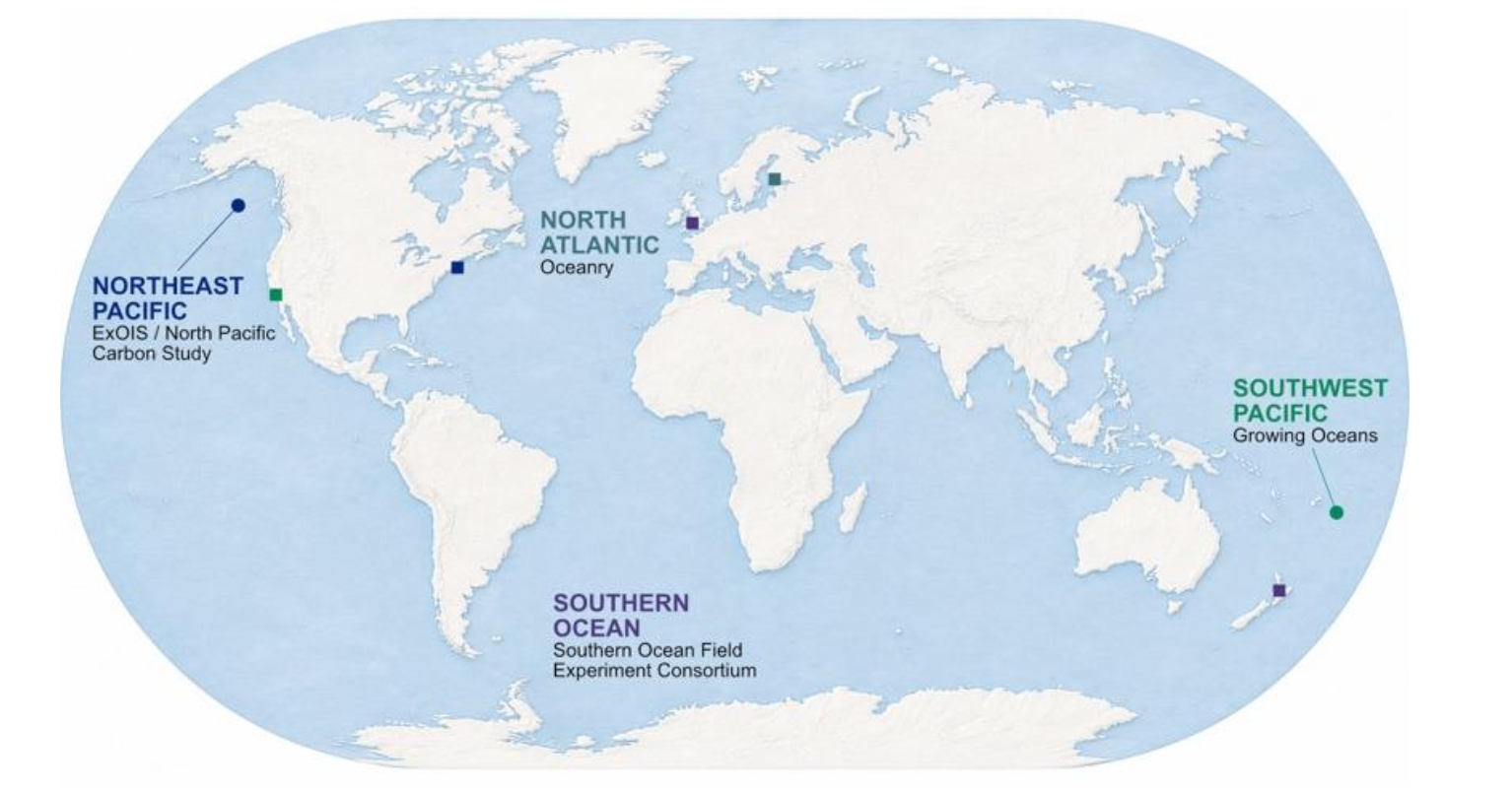
Approximate study regions (circles) and headquarters of coalition organizations (squares). ExOIS is based in Massachusetts, U.S.; Growing Oceans in California, U.S.; Oceanry in Finland; and Southern Ocean Field Research Consortium in New Zealand and the United Kingdom. Environmental responsibility and public engagement are also core commitments of the new coalition.
“Credible science is important, but just as important is building relationships so that communities most affected by climate change can use that research to decide what happens next.” Seth John, Growing Oceans, Director and Chief Scientist.
Members agree that field research should include environmental monitoring and risk assessment appropriate to its scale, seek to minimize environmental risks, and improve understanding of potential ecological and biogeochemical effects. The charter also emphasizes meaningful engagement with relevant rightsholders and consideration of Indigenous knowledge and local perspectives.
The charter is intended as a living framework that can evolve as the science and governance of mCDR develop. Other research organizations whose mission supports its principles may approach the ExOIS Field Research Coalition to discuss membership.
“Transparent, non-commercial research, modelling, and science are the only ways to build trust in ocean restoration. Our research aims to prove that controlled iron replenishment in the Atlantic can be conducted safely, mirroring natural events like volcanic ash or Saharan dust falls without ecological harm. To unlock the ocean’s climate potential, we need open data that shows what works, what doesn’t, and answers the unknown questions. Our goal is to deliver the empirical proof needed for responsible climate action.” Tomi Nyman, Co-founder of Oceanry.
